How to Build Chinese Palace Blocks: Forbidden City & Imperial Palace Set Guide
A complete step-by-step guide to building Chinese palace block sets — Forbidden City and Imperial Palace models. Workspace setup, sorting, symmetry, roof work, and display tips.
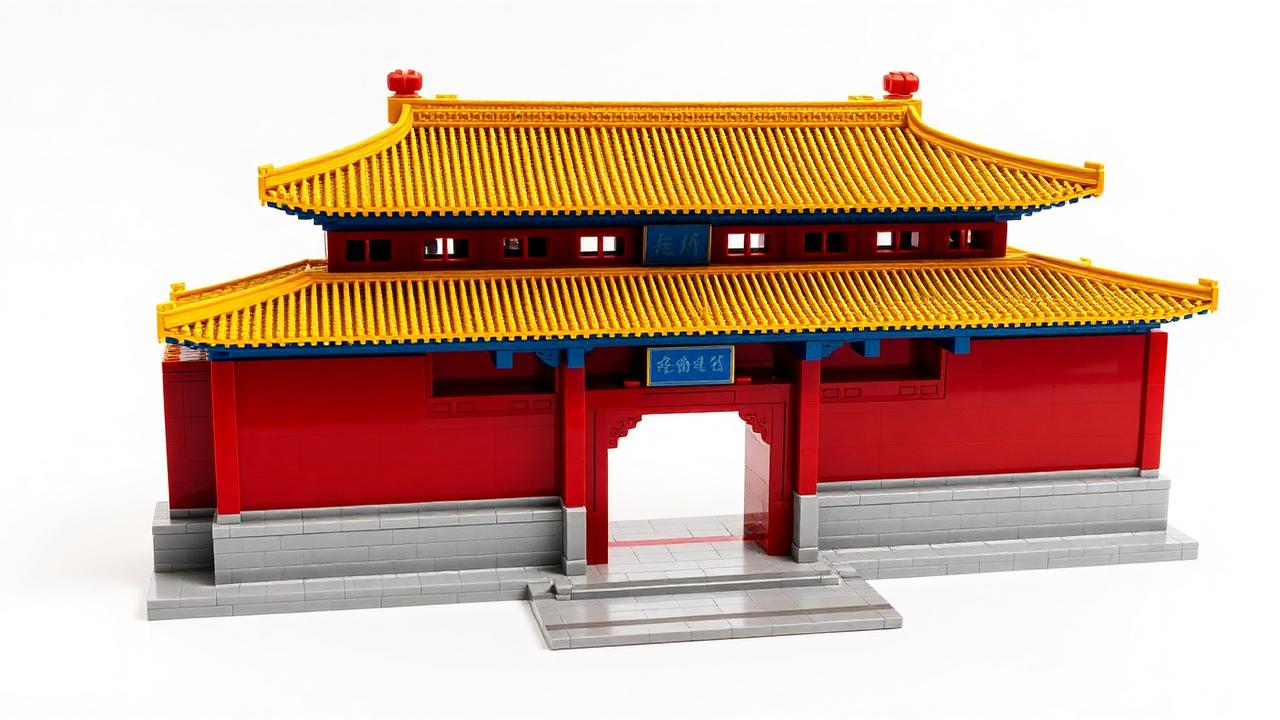
Building a Chinese palace model is not like building a small car, mech, or house. It asks for more patience, more planning, and a better eye for detail. But that is also why many adult builders love it. You do not just snap parts together — you recreate symmetry, roof layers, courtyards, gates, and the visual rhythm that makes imperial architecture stand out.
If you are working on Forbidden City building blocks, an Imperial Palace building set, or other Chinese palace architecture blocks, the build can feel complex at first. Large footprints, repeated patterns, stacked rooflines, and decorative sections all demand a method. Go in without one, and you may waste hours correcting small alignment errors later.
This guide shows you how to build Chinese palace block sets step by step. It covers setup, sorting, structure, symmetry, roof work, display planning, and common mistakes — so you can build cleaner, faster, and with fewer rebuilds. For more architecture-focused models, browse our premium brick collection.
Why Chinese Palace Builds Feel Different
Chinese palace sets have their own logic. They are usually wider than they are tall. They rely on balance, long horizontal lines, layered roofs, and repeated design modules. That means your normal building habits may not always work.
- Strong left-right symmetry
- Repeating window, column, and stair patterns
- Multi-level platforms
- Roof eaves with fine angle changes
- Decorative color blocking — red, gold, black, green, or blue
- Courtyard layouts instead of one compact tower shape
With a sci-fi or city model, a small mistake may stay hidden inside the structure. With Chinese palace architecture blocks, even a one-stud shift can throw off the whole front view. That is why the right process matters more than speed.
Step 1: Choose the Right Build Space
Start with the table before you start with the bricks. A palace build needs room. Many builders underestimate this — they spread pieces too far and lose time searching for small parts.
- A flat table with enough depth for the full model footprint
- Good overhead lighting
- Small trays or containers for sorting
- Side space for instruction booklets and spare pieces
- A soft cloth or mat to protect glossy parts
Set the space for the finished model, not just the current step. Palace sets grow outward — if the base expands more than expected, you do not want to move the model halfway through.
Step 2: Inspect the Set Before You Build
Do not jump straight into Bag 1. First, confirm the main categories are present: base plates, structural bricks, columns and walls, decorative trim, roof slopes, specialty connectors, and small details like lanterns or railings. This step is especially useful for Forbidden City building blocks with many repeating sections — if one roof color group is missing, you want to know early.
Step 3: Sort Pieces by Function, Not Just Color
Many builders sort only by color. For Chinese palace sets, that is often not enough. Red pieces may be columns, plates, tiles, clips, and decorative accents all mixed together.
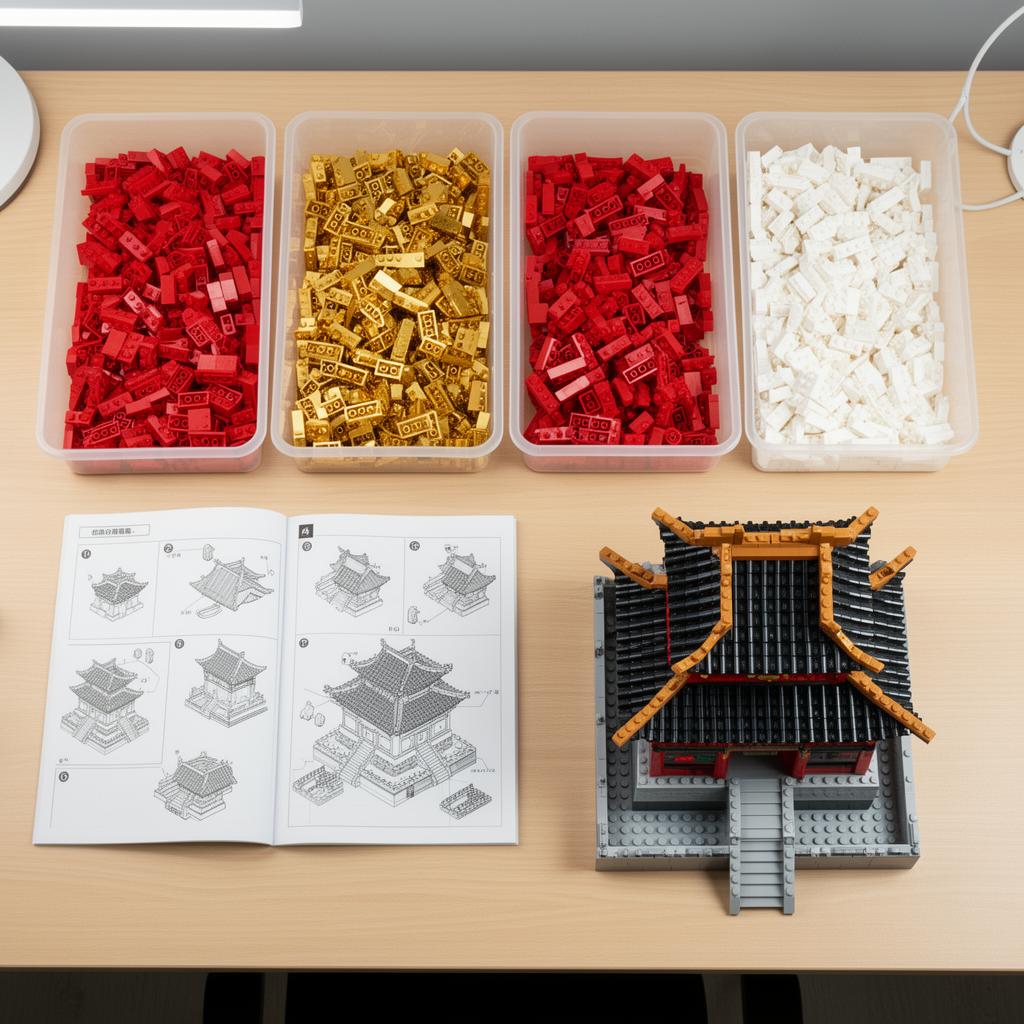
Use separate trays for plates, structural bricks, surface tiles, roof slopes, clip and hinge connectors, and decorative pieces. Palace architecture is repetitive by design — sorting by function lets you recognize build rhythm. Once you understand one gate, one side hall, or one stair section, the rest becomes easier.
Step 4: Read Ahead Before Each Major Section
Before each major section, read a few pages ahead. This matters a lot in an Imperial Palace building set. Look for mirrored builds on the left and right, hidden support points under large roof spans, and decorative assemblies that lock into the main structure later. Read ahead. Build once. Rebuild less.
Step 5: Build the Base Like It Carries the Whole Model
Because it does. A palace model may look light and elegant, but the base supports the walls, raised platforms, and roof weight. Press down every plate layer fully, check corners often, and confirm long seams are locked with overlapping plates. After each main base stage, lift the model gently from opposite sides — if you feel flex, stop and inspect before moving on.
Step 6: Protect Symmetry at Every Stage
Symmetry is the heart of palace architecture. If you lose it early, the model may still hold together, but it will not look right. Doors will sit off-center, roof edges will not match, and stairways will drift. That is a common frustration with Forbidden City building blocks.
- Count studs from the center line outward
- Finish one side, then compare before repeating
- Use a ruler or straight edge for long front sections
- Check top-down alignment after each repeated module
- Do not assume mirrored sections are identical without checking part orientation
Step 7: Build in Modules When Possible
Large palace sets become easier when you think in modules — a gate section, side hall, stair block, courtyard wall, or roof corner. Instead of thinking "I have 2,500 pieces left," think "I am building the left hall now." For more on managing complex builds, see our complete adult building block guide.
Step 8: Handle Roof Sections With Extra Care
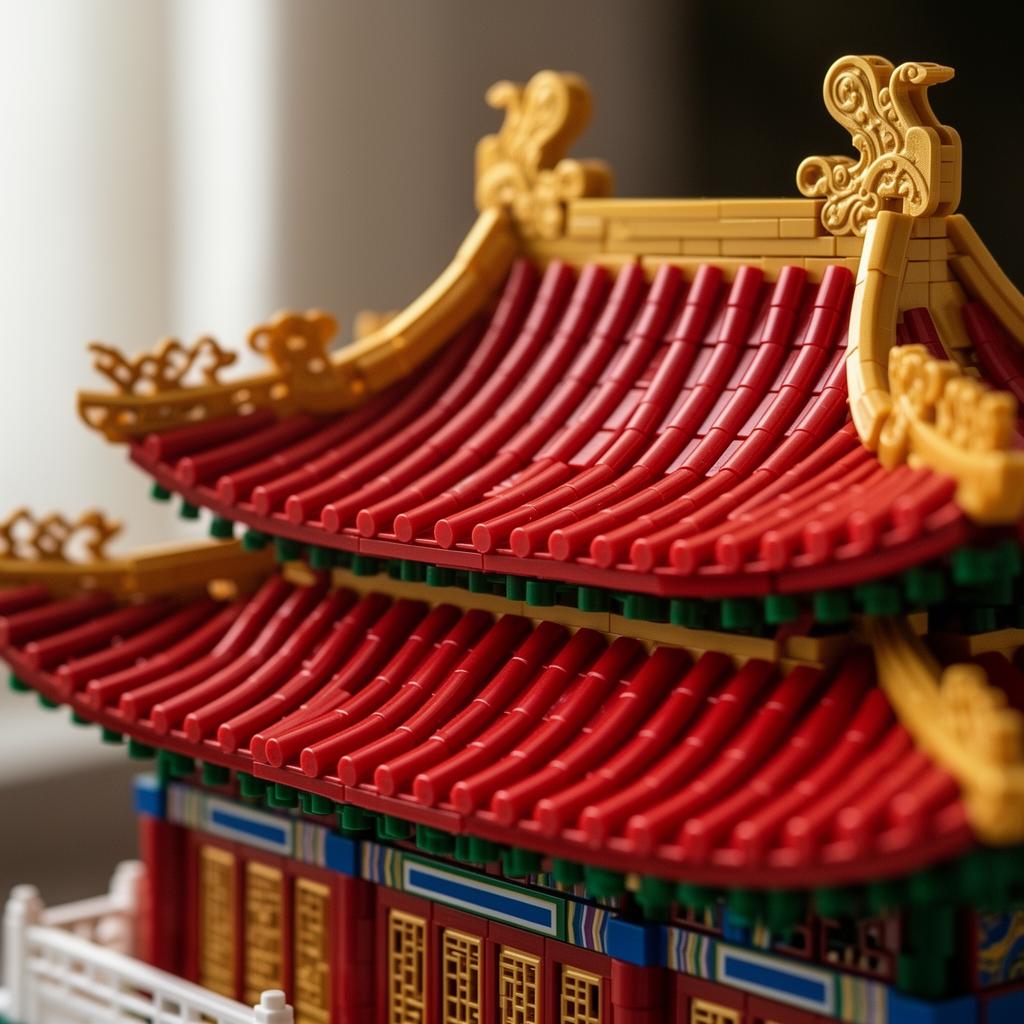
The roof is where Chinese palace models come alive. Build the support frame first — visible roof depth depends on hidden geometry. Check angle consistency: if the left roof wing is even one click different from the right, the mismatch will show from the front. Attach decorative ridge pieces last, since many are fragile. And never lift a palace model by the eaves.
Step 9: Manage Repetition Without Losing Focus
Chinese palace sets often repeat windows, columns, fences, roof trims, and stair details. Repetition can feel relaxing, but it can also cause mistakes when your brain auto-fills the steps. Build in short sessions, finish one repeated group at a time, and check every third or fourth unit against the manual.
Step 10: Use Color and Layering to Understand the Design
Color often signals building logic. Red may mark support columns, gold may emphasize trim, dark tiles may define roof mass, and light stone colors may show raised platforms or stairs. This makes Forbidden City building blocks especially satisfying for display builders and history fans — you are reading an architectural language through the set.
Step 11: Reinforce Weak Sections Before Final Placement
Before you move the completed model, check roof corners, balcony rails, side wings, stair attachments, and any module connected by a narrow base. Press top tiles into place, confirm both roof sides sit level, and inspect for spare parts that may signal a missed step.
Step 12: Display the Model the Right Way
A palace model deserves more than a crowded shelf corner. Place it at chest or eye level, leave visual space around both sides, and avoid direct sunlight. Most palace sets look strongest from a slightly elevated front angle that reveals roof depth. For more architecture display tips, see our Eiffel Tower display guide.
Common Mistakes to Avoid
- Rushing the base — a weak start affects everything above it
- Ignoring symmetry checks — one off-center section becomes a full façade problem
- Mixing similar roof pieces — this distorts roof angles and ridge lines
- Building while tired — decorative details need focus
- Moving the model too early — wait until major sections are locked
- Treating all repetition as automatic — repeated does not always mean identical
- Displaying on an uneven surface — a large footprint shows tilt fast
How to Make the Build More Enjoyable
Build over several sessions, take progress photos, compare completed modules side by side, and add soft lighting near the display shelf for better roof shadow detail. For builders comparing premium options, our guide to premium alternative brands covers what to look for in a quality architecture set.
Conclusion
Building a palace model is part assembly, part planning, and part design appreciation. Whether you are starting with Forbidden City building blocks, choosing an Imperial Palace building set, or exploring other Chinese palace architecture blocks — set up a clean workspace, sort by function, build a strong base, guard symmetry, handle roofs carefully, and display the model where its lines can shine. Build clean. Display proud.
FAQ
Are Chinese palace block sets good for beginners?
Some are, but many are better for intermediate or advanced builders. Palace sets often have repeated sections, layered roofs, and strict symmetry. If you are new, start with a smaller architecture model before trying a large Forbidden City set.
What is the hardest part of an Imperial Palace build?
Usually the roof. Imperial Palace models use angled parts, layered tiles, and delicate trim. A small mistake underneath can affect the whole top section.
How long does it take to build Chinese palace architecture blocks?
It depends on piece count and complexity. A medium set may take several hours. A large display model can take multiple sessions across a few days.
How do I keep large palace models from breaking when moved?
Support the model from the bottom with both hands. Never lift by the roof or side wings. Before moving it, check that all major modules are fully locked and that the base does not flex.
What makes Chinese palace block sets appealing for display?
They have strong symmetry, layered rooflines, and bold architectural detail — giving them a clean, balanced presence that stands out from cars, ships, or standard building sets.