How to Build a Waterfall Set Inside a Multi-Story Bricks Apartment Diorama
A rushing waterfall pouring through the middle of a lived-in apartment building sounds impossible. It isn't. With affordable, compatible bricks, you can build a dramatic **waterfall set** that flows through a detailed **bricks apartment** diorama — and you can do it without paying premium prices.
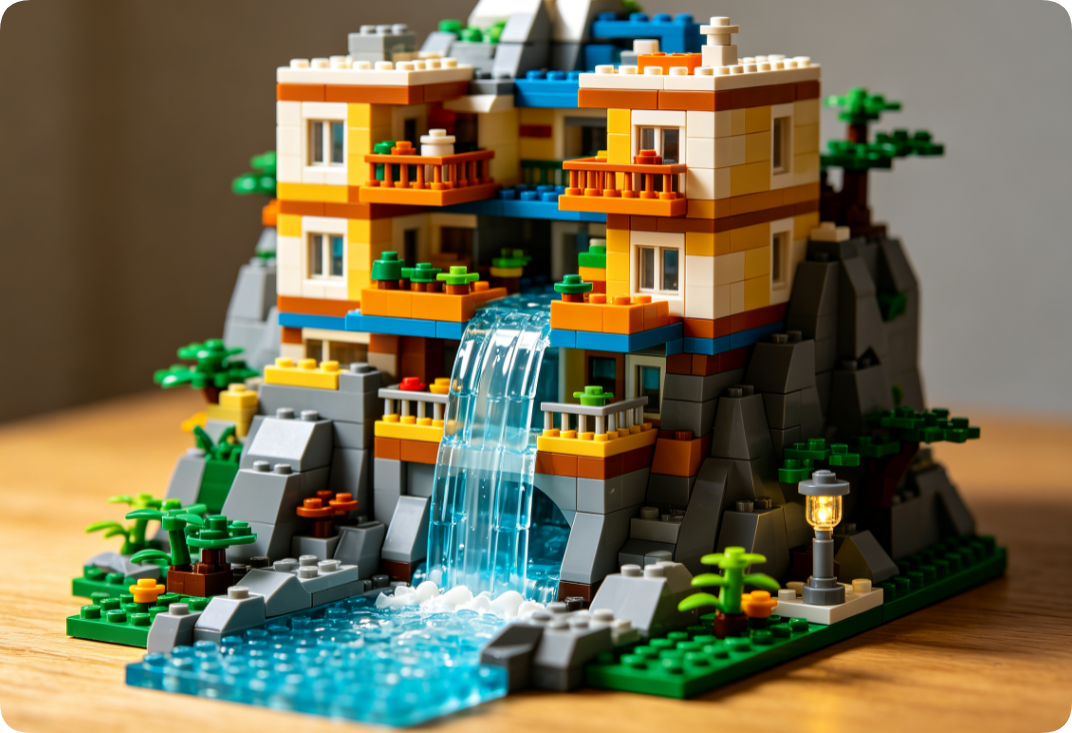
A rushing waterfall pouring through the middle of a lived-in apartment building sounds impossible. It isn't. With affordable, compatible bricks, you can build a dramatic waterfall set that flows through a detailed bricks apartment diorama — and you can do it without paying premium prices.
This guide is for adult hobbyists who want a centerpiece build. You'll learn how to plan the structure, fake convincing water, layer in apartment interiors, and light the whole thing for display. Every technique here works with a lego but not lego system, so you can experiment freely and rebuild as often as you like.
Here's the plan:
- How to design a diorama that combines architecture and nature
- How to source affordable, reliable compatible bricks
- Step-by-step construction of the apartment frame and the waterfall feature
- Interior detailing, lighting, and staging
- Common mistakes and a quick recap
Why an Apartment-and-Waterfall Diorama Works
Most builds pick one theme. A skyscraper. A forest. A castle. This project breaks that rule on purpose.
The contrast that grabs attention
Hard-edged concrete meets wild, tumbling water. Straight window grids sit beside curved, chaotic rockwork. That tension is exactly what makes viewers stop and look twice. It reads brilliantly on a shelf and even better in photos.
A satisfying build for problem-solvers
Engineers, designers, and creative-industry builders love a project with real challenges. Making water look like water in a rigid brick medium is a genuine puzzle. So is routing a "stream" through a functioning apartment layout without breaking the illusion.
The budget advantage
Large dioramas eat parts fast. Hundreds of transparent pieces for water. Dozens of specialty slopes for rock. A full apartment interior. Buying all that in premium brand parts gets expensive quickly.
A quality lego but not lego system changes the math. You can build big, stock extra pieces, and tear down freely when an idea doesn't work. That freedom is where creativity actually lives.
Step 1: Plan the Diorama Before You Build
Skipping the plan is the fastest way to waste bricks. Sketch first, build second.
Decide the footprint and height
A compelling apartment-and-waterfall scene usually needs vertical space. The water has to fall from somewhere. Plan for at least three stories, or a two-story building set against a taller rock cliff.
A base of 32x32 studs gives you room for the building, the waterfall, and a small pool at the bottom. Larger bases allow a foreground with rocks, plants, or a street.
Choose your water's path
Decide where the waterfall originates and where it lands. Popular options:
- Water cascading down an exterior wall from a rooftop garden
- A cliff face built into one side, with the apartment carved into the rock
- An interior atrium where water flows through the center of the building
Set a parts budget
Write your number down before you shop. Transparent and blue elements add up. Deciding on a budget now keeps your ambitions realistic and your build finishable.
Do this first: Draw a side-view sketch showing every floor and the full water drop. This single drawing prevents most structural surprises later.
Step 2: Source Your Bricks the Smart Way
Water and rockwork demand specific pieces. Quality matters as much as price.
What you'll need for the water
- Transparent light-blue and clear plates, tiles, and slopes
- Rounded and curved elements for flowing edges
- A few transparent "1x1" round pieces for splash and spray
- White pieces or trans-white for foam at the base
What you'll need for the apartment
- Consistent-color bricks for walls (grey, tan, or brick red all work)
- Window frames, glass panes, and door elements
- Plates and tiles for floors and balconies
- Technic-style beams if you want internal bracing for height
What to check before buying
- Clutch power: pieces must grip firmly, especially for a tall structure
- Color consistency: transparent blues should match across batches
- Dimensional accuracy: parts must fit standard systems perfectly
- Piece variety: you need slopes, curves, and specialty transparent elements
Step 3: Build the Apartment Frame
Structure comes first. A stable building holds everything else together.
Lay a solid foundation
Start with a large baseplate. Lock a layer of plates over it in an overlapping pattern for rigidity. This base carries the weight of multiple floors plus the rockwork, so don't skimp.
Build floor by floor
Construct each story as you'd expect: outer walls, interior dividers, then a "ceiling" of plates that becomes the next floor. Key tips:
- Stagger your brick courses so vertical seams don't line up. This adds strength and realism to the bricks apartment facade.
- Leave one side or corner open for the waterfall to pass through or beside.
- Add internal bracing on taller builds. Flex at the top means trouble later.
Frame windows and balconies
Windows sell the "apartment" story. Space them evenly for a realistic facade. Add a few balconies with railings — they break up flat walls and give the eye somewhere to rest.
Watch for this: Don't fully seal any floor you plan to detail inside. Leave the front open or make roofs removable so you can reach interiors later.
Step 4: Build the Waterfall
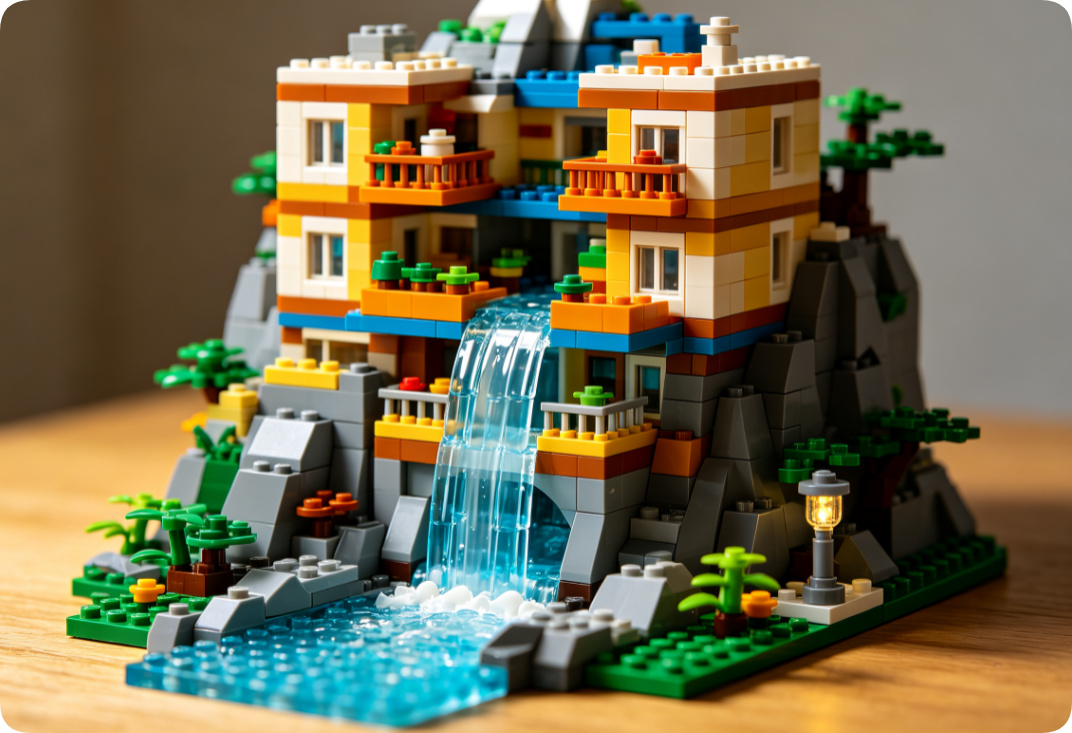
Now the star of the show. This is where a good diorama becomes a great one.
Construct the rock structure first
Water needs something to fall over. Build a cliff or rock ledge using grey slopes and bricks. Vary the angles and depths — real rock is never flat or evenly stepped. Cluster darker greys in recesses and lighter greys on ledges to suggest natural shadow.
Create the falling water
Here's the core technique for a convincing waterfall set:
- Start at the top with a smooth "lip" using tiles, so water appears to spill over cleanly.
- Stack transparent light-blue and clear plates vertically down the rock face. Overlap them slightly for depth.
- Break up the straight fall with a few offset pieces — water bends around rocks.
- Add trans-clear elements at the edges to catch light and suggest movement.
Build the pool and splash
At the base, create a shallow pool with transparent blue tiles and plates. Around the impact point, add:
- White or trans-white round pieces for foam
- Small clear studs scattered outward for spray
- A ring of slightly raised pieces to suggest ripples
Connect water to structure
Blend the waterfall into the apartment. Let water run past a balcony, splash near a ground-floor window, or feed a rooftop garden. This connection is what makes the two halves feel like one scene instead of two builds glued together.
Step 5: Detail the Interiors
An open bricks apartment invites viewers to peek inside. Reward them.
Furnish each room with a story
You don't need to fill every space. A few well-chosen details per room do more than clutter:
- A tiny kitchen with a counter and stools
- A living area with a couch facing a window overlooking the falls
- A rooftop garden feeding the water source
- A cozy bedroom with a bed and small lamp
Use color to guide the eye
Keep walls neutral so furniture and the blue water pop. A restrained palette inside makes the waterfall the clear hero of the scene.
Add human-scale touches
Small props — books, plants, mugs, ladders — bring a diorama to life. They give scale and suggest that people actually live here, right beside a waterfall.
For inspiration on how other builders detail their interiors and water features, browse the community reviews and see which techniques real builders rate highest.
Step 6: Light, Stage, and Photograph
A centerpiece deserves proper presentation.
Light from behind the water
If your build allows, place a small warm LED behind or beneath the transparent water pieces. Backlighting makes trans-blue glow and gives the falls a genuine sense of motion. Interior lights in a few rooms add depth and warmth.
Stage a clean background
A plain neutral backdrop keeps focus on your build. Soft grey or deep blue complements both the concrete and the water.
Shoot at eye level and slightly below
Photographing from your diorama's own level makes it feel monumental. Get low, use side lighting to bring out brick texture, and capture the waterfall from an angle that shows its layered depth.
Share your work
The builder community thrives on ambitious dioramas. Post your build, invite feedback, and swap techniques. Sharing a project like this often sparks your next idea faster than building alone.
Common Mistakes and How to Avoid Them
Even seasoned builders stumble on these.
Flat, single-layer water
The number-one waterfall killer. One sheet of blue looks fake. Always layer overlapping transparent pieces for depth and light play.
Weak structural support
Tall dioramas with heavy rockwork can sag or wobble. Add internal bracing early. Test stability before you commit to detailing.
Overcrowded interiors
Stuffing every room with furniture creates visual noise. Curate a few meaningful details per space and leave breathing room.
Perfectly geometric rocks
Nature isn't symmetrical. Vary your slopes, angles, and colors. Evenly stepped grey blocks read as a staircase, not a cliff.
Mismatched brick quality
Combining low-clutch bricks with reliable ones creates weak joints, especially dangerous at height. Stick to one dependable lego but not lego system so every connection holds firm.
Sealing floors too early
If you close up a floor before detailing it, you'll be tearing walls apart later. Keep interiors accessible until the end.
Quick Recap
Building a waterfall inside a multi-story apartment diorama comes down to six moves:
- Plan the footprint, height, and water path on paper first.
- Source quality transparent and structural bricks with a small surplus.
- Build a braced, staggered apartment frame with removable access.
- Construct the waterfall using layered transparent pieces over varied rockwork.
- Detail interiors with curated, story-driven touches.
- Light and stage the build, then share it with the community.
Ready to start? Sketch your side view, order your transparent bricks, and lay that first foundation plate today. Your apartment waterfall is waiting to flow.
Frequently Asked Questions
How do I make brick water look realistic instead of flat?
Layering is everything. Stack multiple overlapping transparent light-blue and clear pieces down the rock face rather than using a single flat sheet. Break up straight lines with offset pieces, add white foam at the base, and backlight the water if you can. Those layers catch light differently, which is what tricks the eye into seeing movement.
How many pieces does a diorama like this need?
It varies with scale, but a mid-size three-story build typically runs 2,000–4,000 pieces total. Expect several hundred transparent elements for the waterfall set alone, plus structural bricks for the apartment and rockwork. Always buy a surplus of trans pieces — they're the ones you run short on.
Are affordable compatible bricks strong enough for a tall diorama?
Yes, when you choose a quality maker. A well-produced lego but not lego system matches standard dimensions and offers solid clutch power, so tall structures hold firm. The key is buying from a reliable source and adding internal bracing on multi-story builds. Learn more about the brand and its quality standards before you commit to a large project.
I'm newer to complex builds. Is this project too advanced?
Not if you start smart. Begin with a two-story version and a single, simple waterfall drop. Master the layering technique on a small scale, then expand your ambitions on your next build. Every advanced builder started with a first cliff face that looked a little too blocky.
Can I customize this build with my own layout?
Absolutely — that's the whole point of an open brick system. Move the water path, add more floors, build a rooftop garden, or set the apartment into a full cliff face. Treat this guide as a framework, then design a diorama that's unmistakably yours.