How to Judge a LEGO Replica Before You Buy: A Builder's Evaluation Playbook
Not every alternative brick set deserves your money — and not every one is a compromise, either. Some match the originals click for click. A few actually outperform them. The trick is knowing how to tell them apart before you hit "Add to cart."
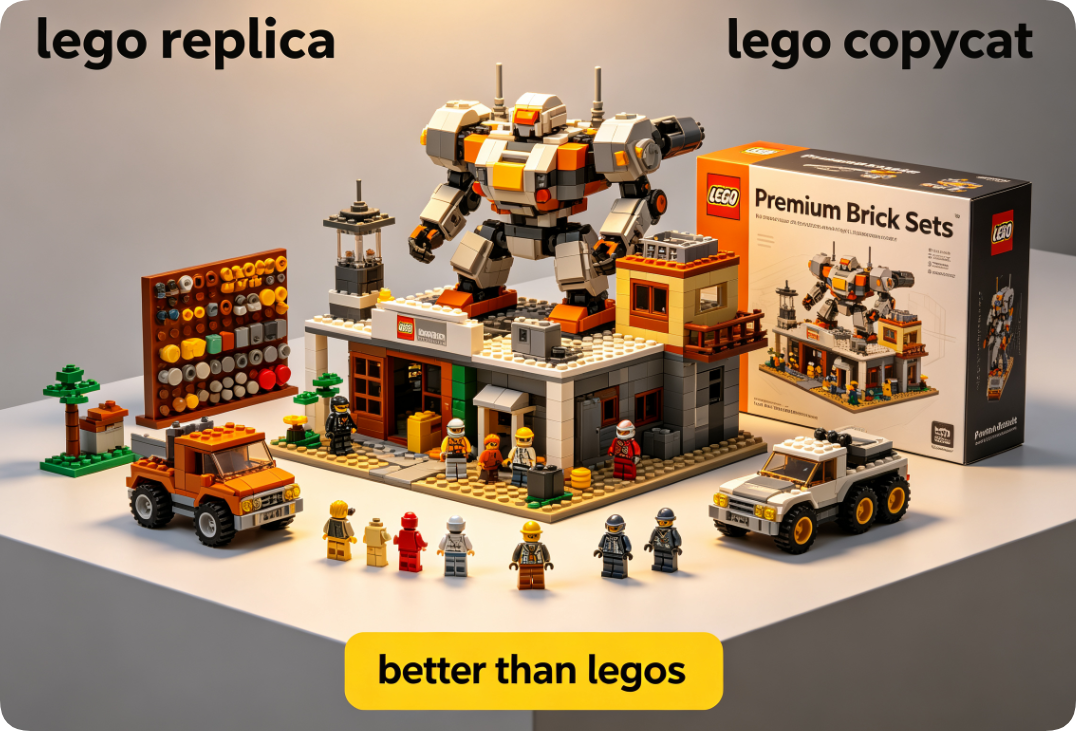
Not every alternative brick set deserves your money — and not every one is a compromise, either. Some match the originals click for click. A few actually outperform them. The trick is knowing how to tell them apart before you hit "Add to cart."
This guide is for adult hobbyists chasing detailed MOCs, families stretching a toy budget, and collectors who want display pieces that hold up. You'll learn a repeatable way to evaluate any lego replica, separate a quality lego copycat from a throwaway one, and figure out when an alternative is genuinely better than legos for what you're building.
Here's what we'll cover:
- How to run a fast quality audit on any set
- The tells that separate premium replicas from cheap ones
- Use cases where alternatives win outright
- A decision framework you can reuse forever
Why "Replica" Doesn't Mean "Inferior"
The word "replica" carries baggage. People hear it and picture flimsy plastic that snaps loose. That reputation is outdated.
Molding technology got cheap and precise at the same time. Independent brands now hit tight tolerances, produce sharp printed elements, and design models that rival — sometimes exceed — official complexity. A well-made lego replica isn't a knockoff of a toy. It's a parallel product built to the same engineering standard.
The 8mm stud system is open. No single company owns it. That means a serious lego copycat can legally match dimensions exactly, so bricks mix freely with what you already own.
Quick recap: Replica quality is now an engineering question, not a status question. Judge the set, not the label.
Step 1: Run the Five-Minute Quality Audit
Before you fall for render photos, run this check. It takes five minutes and saves you from most bad buys.
Check the Mold Grade
Look at close-up product shots. Sharp, clean edges signal fresh molds. Fuzzy corners, visible seams, or rounded studs signal worn tooling.
A premium lego replica shows crisp corners on every stud and clean text on printed tiles. If a seller won't show macro photos, that's your answer.
Verify Clutch Power Through Reviews
Clutch power — the grip between bricks — can't be felt online. So read for it.
Scan reviews for two failure words: "loose" and "stuck." Loose bricks mean your model sags. Stuck bricks mean kids can't separate them. You want firm-but-releasable, and real builders will say so plainly.
The CraftBlockWorld reviews page is a good model for this — actual builders reporting on fit and finish, not marketing copy.
Confirm Color Consistency
If you plan to combine sets, color matching matters. A dark gray from one batch shouldn't clash with the next.
Brands that mold in-house hold color far better than those sourcing random pieces. Look for language about production control, and check user photos for shade drift.
Weigh the Instructions
Clear manuals separate a relaxing build from a frustrating one. Full-color steps, numbered part callouts, and a digital backup are the marks of a serious product.
Quick recap: Audit mold sharpness, clutch power via reviews, color consistency, and manual quality. Four checks, five minutes, most duds eliminated.
Step 2: Spot a Premium Copycat vs a Cheap One
All alternatives are not equal. Two sets at similar prices can deliver wildly different experiences. Here's how to read the difference.
The Packaging Tell
Cheap sets cut corners you can see before opening. Bricks dumped in one loose bag. No numbered stages. A single folded instruction sheet.
Premium sets bag parts by build phase, protect printed pieces, and include a bound manual. Packaging discipline predicts build discipline.
The Piece-Count Trap
A big number sells boxes. It doesn't guarantee a good model.
Some brands pad counts with filler — tiny 1x1 plates that inflate the total without adding detail. A thoughtfully designed 1,800-piece lego copycat often beats a padded 2,800-piece one on looks and build satisfaction.
Judge finished size and detail density, not the headline number.
The Support Signal
A quality brand plans for missing bricks. It happens to every manufacturer, even premium ones. What matters is the fix.
Look for a clear replacement-parts policy and responsive support. A cheap lego copycat vanishes after the sale. A serious one sends you the missing gear within days. You can usually gauge a company's stance on this by reading its company background.
The Detail Density Test
Zoom into a finished-model photo. Count the functional details: opening panels, working mechanisms, textured surfaces, printed elements.
Cheap sets rely on stickers and flat facades. Premium sets build detail into the structure itself. Stickers peel; molded detail lasts.
Quick recap: Packaging discipline, honest piece counts, real support, and structural detail separate premium replicas from disposable ones.
Step 3: Know When an Alternative Wins Outright
Sometimes an alternative isn't just "good enough." It's the smarter buy. Here are three use cases where sets are genuinely better than legos.
For Adult MOC Builders
MOC means "My Own Creation" — custom builds using loose parts. If you design your own models, you buy for parts, not for the finished picture.
This is where alternatives shine. Many offer versatile element packs, unusual connectors, and generous color ranges at a lower cost per piece. More raw material, less money, means more freedom to experiment.
For pure part variety and value, alternatives are frequently better than legos for the MOC crowd. You're not paying a licensing premium for pieces you'll take apart anyway.
Mini-scenario: A builder wants 400 dark-green plates for a landscape base. An official parts order runs high. A well-priced alternative set delivers the same plates for a fraction, freeing budget for the details that actually show.
For Display-Focused Collectors
Collectors want shelf presence. A model that looks sharp under a lamp and holds its lines over years.
Certain alternative brands specialize in architecture and large-scale display models that never existed as official products. Unique themes, exclusive designs, and dramatic scale — that's collector catnip.
Here, "replica" becomes irrelevant. You're buying an original design that happens to be brick-compatible. When the design is exclusive and the build quality is high, an alternative is easily better than legos for a display shelf.
For Budget-Conscious Families
Parents want STEM value without the sticker shock. Building sets sharpen spatial reasoning, patience, and fine motor skills — regardless of the logo on the box.
A family can afford more building hours per dollar with a quality alternative. That means more shared projects, less screen time, and a bigger parts collection to grow with.
For maximizing learning per dollar, alternatives are often better than legos at the family level. The educational payoff is identical; the price is not.
Quick recap: Alternatives win for MOC part value, exclusive display designs, and family budgets — three clear cases where they beat the originals.
Step 4: Match the Set to Your Skill Level
A great set at the wrong difficulty ruins the experience. Buy for where you are.
Beginner
Start with 300–800 pieces and clear staged instructions. The goal is a satisfying finish, not a marathon. Sets with strong internal structure forgive small mistakes.
Intermediate
Move to 800–2,000 pieces with some mechanical elements — gears, hinges, moving parts. This is the sweet spot for relaxing weekend builds.
Advanced
Go 2,000+ pieces with complex sub-assemblies and working mechanisms. Expect ten-plus focused hours. The challenge is the reward.
Creator
Skip the finished-model logic. Buy for parts richness, color range, and connector variety. Every set becomes raw material.
Quick recap: Beginners want quick wins, intermediates want moving parts, advanced builders want long challenges, creators want versatile parts.
Step 5: Use This Decision Framework
Here's the whole evaluation compressed into a reusable rule set. Run any set through it.
- Mold grade — Sharp studs and clean prints? Pass.
- Clutch power — Reviews report firm-but-releasable fit? Pass.
- Color consistency — In-house molding, no shade drift? Pass.
- Instructions — Full-color, staged, digital backup? Pass.
- Honest count — Detail matches the number, no filler? Pass.
- Support — Clear replacement-parts policy? Pass.
- Purpose fit — Right for MOC, display, family, or skill level? Pass.
A quality lego replica clears this framework easily. A cheap one fails at packaging, support, or detail — usually all three.
Quick recap: Seven checks. Six-plus passes means buy. It's that simple.
Putting It Into Practice
Say you're an adult builder eyeing a 1,600-piece modular building. Run the framework.
Macro photos show crisp studs — pass. Reviews praise the fit — pass. The brand molds in-house — pass. Full-color staged manual — pass. Detail lives in the structure, not stickers — pass. Clear replacement policy — pass. It suits your intermediate skill and display goals — pass.
Seven for seven. That's a confident buy, and likely one that's better than legos on value for exactly your use case.
Now flip it. A "2,500-piece bargain" arrives in one loose bag, with a photocopied sheet and no support contact. Two passes. Walk away — that's the lego copycat giving the category a bad name.
Quick recap: The framework turns a gut decision into a scored one. Trust the score.
Conclusion
A lego replica is only as good as the engineering behind it. Judge the mold, the clutch power, the color control, and the support — not the label on the box. Use the seven-point framework and you'll rarely buy a dud.
And remember: for MOC builders, display collectors, and budget-minded families, the right alternative isn't a compromise. It's the better tool for the job.
Next step: run one set through the framework today. Explore your options at CraftBlockWorld and put a set to the test.
Frequently Asked Questions
Is a lego replica compatible with original bricks?
Yes, in almost every case. Quality replicas build to the open 8mm stud standard, so they connect freely with bricks you already own. Confirm the listing states compatibility and check reviews for clutch-power feedback before buying.
How do I tell a good lego copycat from a cheap one?
Look at four signals: packaging discipline (parts bagged by stage), honest piece counts without filler, structural detail instead of stickers, and a clear replacement-parts policy. A premium lego copycat passes all four; a disposable one fails most.
Are alternatives really better than legos, or is that marketing?
It depends on your use case. For custom MOC builders needing part variety, display collectors wanting exclusive designs, and families maximizing learning per dollar, alternatives are frequently better than legos on value and selection. For those specific goals, the advantage is real.
Do replica sets come with instructions and replacement parts?
Quality ones do. Expect full-color, staged manuals with numbered callouts, often plus a digital backup. Reputable brands also handle missing bricks quickly through a stated replacement policy — a key sign you're buying from a serious company.
What size set should a first-time builder start with?
Begin with 300–800 pieces and clear staged instructions. The aim is a satisfying, low-frustration finish. Once you enjoy the process, move up to 800–2,000-piece sets with moving parts for a bigger challenge.