Building a Lego Old West Scene: Train Steampunk Locomotive Meets Theatre Balcony
Learn to build a lego old west scene with a train steampunk locomotive and detailed theatre balcony using standard, sourceable brick pieces.
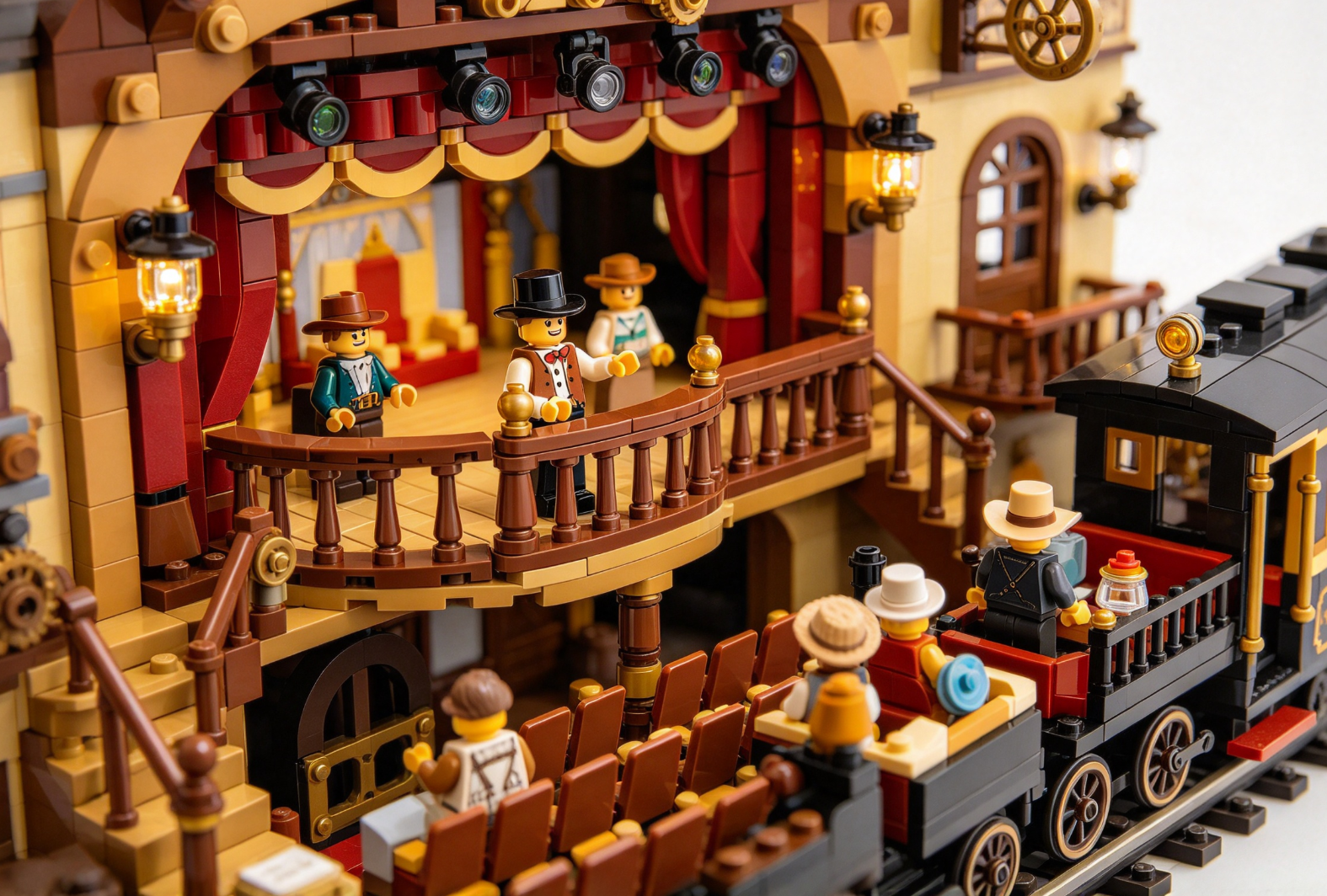
Quick answer: A lego old west scene combining a train steampunk locomotive and a theatre balcony works best when built in three separate modules — engine, saloon-theatre, and street — then connected with a shared baseplate and color palette. CraftBlockWorld bricks in aged brass, rust orange, and weathered wood tones replicate the frontier-meets-industrial look without needing rare or discontinued parts.
Frontier towns and steam-powered machinery make an unlikely but satisfying pair. One represents raw, dusty expansion. The other represents brass, pressure valves, and mechanical ambition. Put them on the same baseplate, and you get a scene with real visual tension — something most standard Old West sets never attempt.
This guide walks through building a complete lego old west diorama featuring a train steampunk locomotive pulling into a frontier town, with a saloon-theatre anchored by a detailed theatre balcony overlooking the main street. Every step uses parts available through CraftBlockWorld's catalog, so builders in Europe and North America can source pieces without hunting down discontinued LEGO® sets.
What Makes a Lego Old West Build Unique
Most western-themed brick sets stick to a narrow formula: a saloon, a sheriff's office, maybe a horse or two. A lego old west build with steampunk elements breaks that formula by introducing mechanical detail into a setting that's usually associated with dust and wood.
The contrast matters. Steampunk design leans on brass pipework, exposed gears, and pressure gauges — elements that read as futuristic-for-their-era. Old West architecture leans on rough plank siding, false-front buildings, and hitching posts. When a train steampunk locomotive rolls into a town built from these classic western pieces, the scene tells its own story without needing a written backstory.
A theatre balcony adds a second layer of contrast. Saloon theatres in frontier towns were often the most ornate buildings on the street — velvet curtains, carved railings, oil lamps — set against otherwise plain construction. Building a raised balcony with these details gives the eye a focal point that pulls the whole scene together.
This combination also solves a practical problem for adult builders: it avoids repeating what's already been covered in typical steampunk vehicle or car-conversion builds. Instead of retrofitting a road vehicle, this project treats the locomotive as a standalone centerpiece within a larger environment.
Planning Your Scene: Train, Theatre, and Town Layout
Before pulling out a single brick, sketch a rough footprint. A functional lego old west scene needs at least three zones:
- The rail line — running along one edge of the baseplate, wide enough for the train steampunk locomotive and at least one car.
- The saloon-theatre — positioned facing the street, tall enough to support a theatre balcony on the second floor.
- The street and storefronts — smaller buildings, a hitching post, boardwalk, and background details that fill out the town.
Color planning matters as much as layout. Reserve brass, copper, and aged bronze tones for the train steampunk elements. Keep the town buildings in weathered wood browns, tans, and faded reds. The theatre balcony should borrow a little from both palettes — dark wood framing with a few brass or gold accents — so it visually bridges the two halves of the scene.
Materials and Bricks You'll Need
This build relies on standard brick shapes rather than rare specialty pieces, which keeps sourcing simple. Here's the core parts list:
- Wheels and axles: Large train wheels or technic wheels in dark gray or black for the locomotive.
- Brass/copper-toned bricks and tiles: For boiler details, pipework, and gauges on the train steampunk engine.
- Transparent round tiles or 1x1 round plates: Used as pressure gauges and lamp lenses.
- Bar and clip pieces: Essential for railings on the theatre balcony and exterior pipe fittings.
- Wood-tone bricks (tan, reddish-brown, dark brown): For the saloon-theatre facade and street-level storefronts.
- Arch and window pieces: For theatre entrances and upper-floor windows.
- Fence and lattice pieces: Ideal for the balcony railing and boardwalk trim.
- Minifigure accessories: Top hats, parasols, and vests for Old West characters; goggles and leather aprons for steampunk-styled figures.
Step 1: Build the Train Steampunk Locomotive
Start with the chassis. Lay down a base plate roughly 6 studs wide and 16-20 studs long, depending on how large the finished locomotive should be. Attach large wheels toward the front and rear, leaving space in the middle for the boiler section.
Build the boiler as a cylindrical or semi-cylindrical shape using curved slopes stacked in brass and copper tones. This is where the train steampunk identity comes through most clearly — layer in small round tiles as rivets, add a few 1x1 round transparent pieces as glowing pressure gauges, and attach thin bar pieces along the sides to represent exposed pipework.
The cab sits toward the rear of the locomotive. Use darker wood-tone bricks here to suggest a mix of iron framework and timber paneling, a detail that ties the machine visually back to the frontier setting rather than making it look purely futuristic.
Finish with a tall funnel stack, slightly tapered, positioned above the boiler. A small puff of light gray or white plates arranged loosely at the top can suggest steam without needing printed smoke pieces.
For builders who want a second rail car, a simpler flatbed or passenger car in matching wood and brass tones extends the scene without doubling the workload.
Step 2: Construct the Theatre Balcony
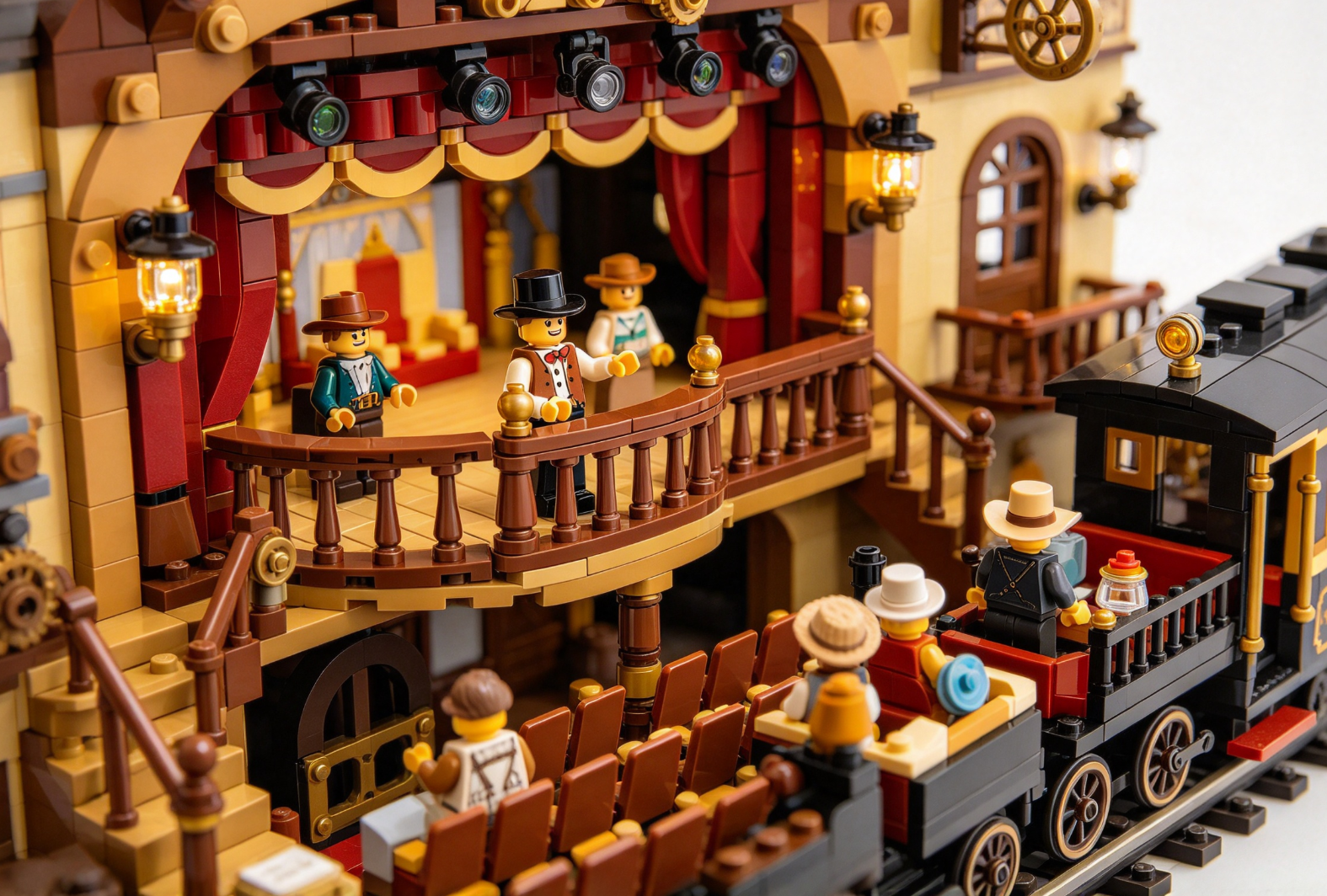
The saloon-theatre building anchors the town side of the scene, and the theatre balcony is its most important architectural feature.
Begin with the ground floor. Build a facade roughly 10-12 studs wide using tan or reddish-brown bricks, with a centered double-door entrance using arch pieces. Add a covered boardwalk section extending forward, supported by simple round or square columns.
For the second floor, set the walls back slightly from the ground floor edge, then extend a platform outward to create the balcony itself. Use plate pieces for the balcony floor, then attach a railing made from bar and clip pieces or thin fence sections. A few gold or brass 1x1 tiles worked into the railing design nod to the steampunk influence, without turning the balcony into an over-decorated centerpiece.
Windows on the upper floor should use small arch or lattice window frames, ideally with a rounded top to suggest theatre-style elegance. If available, add a small overhang or awning above the balcony using slope bricks in a contrasting dark color — this creates shadow definition and makes the balcony read clearly from a distance.
Interior detail is optional but adds a lot of payoff for adult builders. A small stage visible through the ground-floor windows, built from red and gold tiles, suggests a working theatre rather than just a facade.
Step 3: Assemble the Old West Street Scene
With the locomotive and saloon-theatre complete, the street ties the whole lego old west scene together.
Lay a baseplate section between the rail line and the saloon-theatre to represent the main street. Use tan or gray plates for a dirt road, with a raised boardwalk running along the theatre's side using flat tan or brown tiles.
Add one or two smaller storefronts — a general store, a blacksmith, or a telegraph office — using simpler builds than the main theatre. These don't need heavy detail; their job is to frame the scene and give the eye somewhere to rest before returning to the main theatre balcony structure.
A hitching post, a water trough, and a few barrels scattered near the storefronts fill out the space without adding much build time. Minifigures work best when placed with intent: a sheriff figure near the storefronts, a couple of theatre-goers glancing up toward the balcony, and an engineer figure with goggles positioned near the train steampunk locomotive.
Step 4: Add Details and Finishing Touches
Small details separate a good lego old west build from a great one. Consider these finishing additions:
- Lighting elements: Battery-powered LED brick lights placed inside the boiler or behind theatre windows add a lived-in glow, particularly effective for photography.
- Signage: Printed or custom tile signage above the saloon-theatre entrance ("Grand Palace Theatre" or similar) gives the building identity.
- Weathering effects: Mixing brick shades slightly — a few darker tan bricks among lighter ones — mimics sun-faded wood without needing custom paint.
- Steam effects: White or light gray 1x1 round plates stacked loosely near the funnel stack suggest steam in motion.
- Ground texture: Adding a few uneven tan or gray plates to the street breaks up the flatness of a single-color baseplate.
Tips for Working with Lego Substitute Bricks
Builders new to non-LEGO® brands sometimes worry about compatibility or fit. In practice, most reputable brick brands — including CraftBlockWorld — manufacture to standard stud and clutch specifications, so pieces connect the same way LEGO® bricks do.
A few practical tips for this specific build:
- Test-fit before committing to color schemes. Brass and copper tones vary slightly between brands and product lines. Order a small batch first if color matching across the train steampunk locomotive and the theatre balcony railing matters to the finished look.
- Sort by function, not just color, particularly for small round tiles and bar pieces used across both the locomotive and balcony sections. These parts get used in multiple places, so having them separated by purpose speeds up the build.
- Use a brick separator for the tightly packed boiler and balcony railing sections, where fingers alone struggle to pull pieces apart cleanly.
- Check reviews before ordering large batches. CraftBlockWorld's builder reviews page includes feedback from other adult builders on fit, color accuracy, and durability across different collections.
Bringing the Scene Together
A finished lego old west scene with a train steampunk locomotive and a detailed theatre balcony rewards patience more than skill. None of the individual techniques here are advanced — curved slopes, bar-and-clip railings, arch windows — but combining them across three connected structures takes time and planning.
Builders working through this project for the first time should expect to spend a full weekend on the locomotive alone, with the saloon-theatre and street taking a similar amount of time. Splitting the build into the three modules described above makes it manageable in shorter sessions, and each module works as a standalone display piece if the full scene isn't finished right away.
Once complete, the contrast between brass-and-steam machinery and dusty frontier architecture gives this build a visual identity that's hard to find in standard western-themed sets — and a strong candidate for photography, community sharing, or a permanent spot on a display shelf.
Frequently Asked Questions
Do I need LEGO®-brand pieces to build this scene?\ No. Any brand manufactured to standard stud specifications, including CraftBlockWorld bricks, connects and fits the same way. The techniques in this guide use standard brick shapes rather than brand-specific or discontinued parts.
How many pieces does a build like this typically require?\ A complete scene with the locomotive, saloon-theatre, and street section generally falls between 1,500 and 2,500 pieces, depending on how much detail is added to the storefronts and background elements.
Can the train steampunk locomotive be built as a standalone project?\ Yes. The locomotive works as an independent display piece and doesn't require the theatre or street sections to look complete. Many builders start there before expanding into the full town scene.
What's the best way to get the brass and copper color scheme right?\ Order a small test batch of brass, copper, and aged bronze pieces before committing to a full parts order. Color tone can vary slightly between product lines, and matching the locomotive to the theatre balcony railing works best when checked in person first.
Is this build suitable for beginners?\ The individual techniques are beginner-friendly, but the overall scope — three connected structures — suits builders with at least some prior experience. First-time builders can start with just the saloon-theatre or the locomotive before attempting the full layout.